
Quick answer
Customer service training usually fails because it only works on behaviour: scripts, phrases, a friendlier tone. Under pressure, people don't reach for what they were taught. They fall back on how they feel. Training sticks when it works on what drives the behaviour. These are the psychological needs of the people serving customers, and the way their leaders treat them. Change that, and the behaviour follows.
What usually happens after customer service training?
You know the pattern. The training day goes well. People are engaged, the feedback forms are glowing, someone says it was the best training they've had in years. Two weeks later, the call recordings sound exactly the way they did before.
It's tempting to blame the delegates. They weren't paying attention, they don't care, they went back to old habits. But I started my professional career as a call centre sales agent, and I can tell you it's rarely about not caring. The people on your front line usually know exactly what good service sounds like. They just can't produce it at 4pm on a Friday, on their fortieth call, with an angry customer and a team leader watching their handling time.
In the call centre I worked in, we were told to be hungry for money. Our time on the phone was monitored and punished if it was too low. Our chairs were taken away on a Monday morning and only returned after we had made our first sale. We were treated like resources. I felt unseen, replaceable and trapped. So I treated my customers badly. I didn't care what they said. I spoke badly about them if they didn't buy. And I spoke badly about the company. I was actively disengaged and looking for a new job to escape to.
They tried to train us, but it fell flat. Because we hated working there and were treated badly. We were being trained how to behave, and no one was addressing our psychological needs or the way we were managed.
The training didn't fail because people forgot it. It failed because it was aimed at the wrong level.
Why do scripts and techniques fade so fast?
Scripts live in the thinking part of us. A difficult customer hits somewhere else entirely.
Transactional Analysis gives us a useful way to see this. When we're calm and resourced, we operate from what Eric Berne called the Adult ego state. Present, thinking, and able to choose a response. Under pressure, most of us slip out of it. Some people go into a Critical Parent mode and start quoting policy. Others drop into an Adapted Child mode and placate, over-apologise or freeze. Customers feel the shift immediately, even if the words on the script are perfect.
No script can override a state. You can't script your way out of feeling threatened. What you can do is help people recognise the state they're in and give them a way back to the Adult, which is a very different kind of training from "say this, not that".
What actually drives how people treat customers?
We were told to be hungry for money. The hungers that actually drove us were different. Eric Berne described a set of psychological hungers. Three of them matter enormously at work: structure, recognition and stimulus. When these hungers go unmet, it shows up in the service your customers receive.
- Structure: when processes are unclear, targets keep moving and nobody knows who makes the call, people become anxious. Anxious people give rigid, defensive service.
- Recognition: when the only feedback an agent gets is about what went wrong, they learn to protect themselves. Self-protection sounds transactional on a call.
- Stimulus: when every hour looks the same, people go onto autopilot. Customers can hear autopilot.
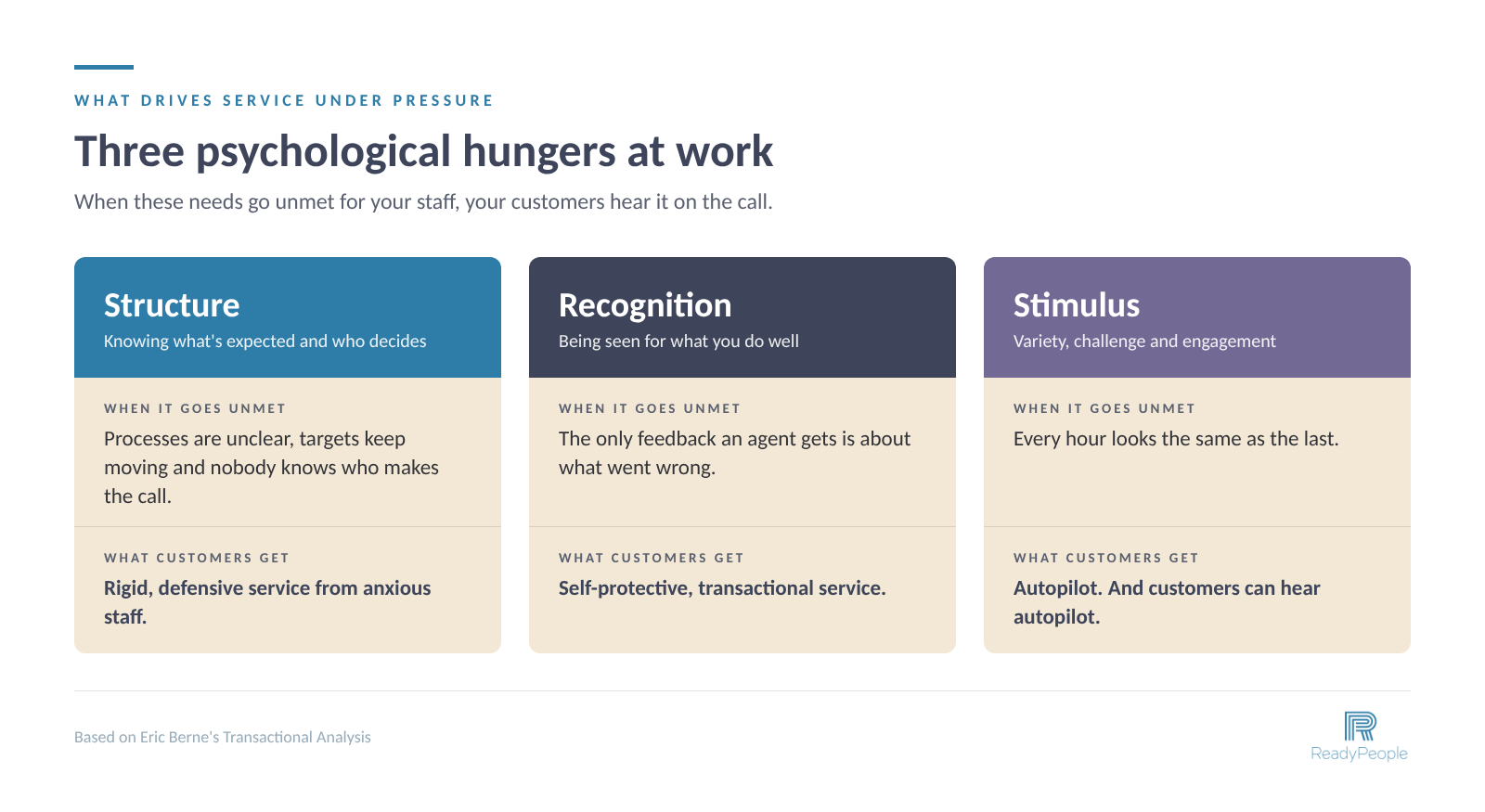
This is why customer experience mirrors employee experience. Your customers end up feeling roughly what your staff feel. If you want to change the first, you have to work on the second.
Where do team leaders fit in?
Service teams mirror how they're led. If a team leader only appears on the floor to correct someone, agents learn that visibility means danger. If a team leader stays curious when a call goes badly, agents learn that it's safe to think.
That's why training the front line on its own so often disappoints. You send people on a course, then return them to exactly the same system that produced the old behaviour. The team leader is the system they return to. Any customer service programme that skips the team leaders is betting against the environment, and the environment usually wins.
How do you choose customer service training that sticks?
If you're buying customer service or CX training, these are the questions I'd ask of any provider, including us:
- Does it start with why people behave the way they do, or only with what to say? Scripts have their place, but they're the last layer, not the first.
- Does it give staff a model they can use under pressure? People need a way to notice their own state in the moment and recover from it.
- Are team leaders part of it? If the leaders don't change how they respond, the front line won't either.
- Is there pre-work and follow-up? A single day with nothing before or after is an event, not a change process.
- Is it measured on customer outcomes? NPS, complaints, compliments and repeat calls, not how the day felt.
Does this approach show up in the numbers?
In February 2025 we ran our customer experience programme for the claims and underwriting teams of a flagship product inside a major South African financial services group: two full-day workshops a few weeks apart, delivered in person in Cape Town and Johannesburg, to 117 delegates.
In the four months that followed:
- The underwriting team's average NPS rose from 10.16% to 23.73%, an increase of 13.57 percentage points.
- Promoter responses rose from an average of 46.11% to 54.18%.
- The claims team's NES score improved by 3.01%, with Promoter responses across the claims value chain averaging 76.41%.
The programme didn't hand people better lines. It worked on psychological hungers, ego states, difficult customers and listening, and it was backed by team leader coaching afterwards. The behaviour changed because what sat underneath it changed.
Summary: before you book your next customer service training
- Customer service training fails when it only targets behaviour.
- Under pressure, people act from their state, not their script.
- Unmet needs for structure, recognition and stimulus show up as poor service.
- Team leaders decide whether new behaviour survives the first week.
- Judge training by what happens to your customer metrics afterwards, not by the feedback forms.
If your service teams have had the training and the calls still sound the same, let's talk. I'll tell you honestly whether we can shift it.

Clive Vanderwagen is the founder of ReadyPeople Training & Coaching Consultancy. He is an ICF Professional Certified Coach (PCC) with Advanced Certification in Team Coaching (ACTC), a TEDx speaker and the author of Thriving Culture. He has trained and coached thousands of professionals, from C-suite leaders to frontline service teams.
← Back to all articles